04 August 2023

The Australian Government refuses to say what it knows about climate-security threats, so we gave policymakers a helping hand

By David Spratt

Last year the Australian Government asked the Office of National Intelligence (ONI) to assess climate-related security risks. Due to time constraints, ONI looked at the global and regional picture, but not the domestic one, and their report was given to the government last November.  

Eight months later, the Prime Minsters’ Office has decreed that the report is not to be released, even in a declassified form. This is contrary to the practice of the government that the prime minister likes to call our best ally, which regularly releases climate and security assessments, such as Climate Change and International Responses Increasing Challenges to US National Security Through 2040. Likewise, the Pacific Islands Forum has just published a Pacific Climate Security Assessment Guide.

28 June 2023

What scientists say...

Scientists in their own words provide a compelling way to communicate often-complex ideas. So we have put together a small collection of useful quotes, with more to come.

You can find them at the Links & Info tab on the navigation bar. Here is a selection.

Societal collapse

Prof. HANS JOACHIM SCHELLNHUBER, August 2018
"Climate change is now reaching the end-game, where very soon humanity must choose between taking unprecedented action, or accepting that it has been left too late and bear the consequences.”
      Foreword to What Lies Beneath
      breakthroughonline.org.au/whatliesbeneath

Dr JOELLE GERGIS
"It’s extraordinary to realise that we are witnessing the great unravelling; the beginning of the end of things. I honestly never thought I’d live to see the start of what sometimes feels like the apocalypse. The Earth is really struggling to maintain its equilibrium. It’s possible that we are now seeing a cascade of tipping points lurching into action as the momentum of instability takes hold and things start to come apart.”
      Living with extremity as the new normal     
      griffithreview.com/articles/elemental-summer-a-season-of-chang

21 June 2023

Three climate interventions: Reduce, remove, repair

Courtesy Climate Crisis Advisory Group

In September 2022, Stockholm University’s David Armstrong McKay and his colleagues concluded that even global warming of 1-degree Celsius risks triggering some tipping points, just one data point in an alarming mountain of research on tipping points presented in the last year and a half. Clearly, even the current level of warming of around 1.2°C is unacceptably dangerous.

To protect small-island states, the Great Barrier Reef, Antarctica, Greenland, the Amazon — indeed to provide protection for the many places and people we care about — requires returning to a climate similar to the relatively stable Holocene conditions of the last 9000 years and fixed human settlement, during which time carbon dioxide (CO2) levels did not exceed 280 parts per million (ppm) CO2. it also requires preventing a cascade of tipping points in the meanwhile.

12 June 2023

Dramatic Arctic sea-ice news should not be a shock: We were warned.

by David Spratt

It's almost unthinkable. The Arctic Ocean blue all over in summer, with none of the eight million square kilometres of sea-ice — a thin frozen white crust floating on the ocean surface — that covered it in summer just 40 years ago.

No wonder it made headlines this month when researchers found, as reported by The Washington Post, that "a summer in which the Arctic Ocean features almost entirely open water could be coming even sooner than expected and may become a regular event within most of our lifetimes".

The research is "Observationally-constrained projections of an ice-free Arctic even under a low emission scenario", and was published in Nature on 6 June 2023.   It projected "an ice-free Arctic in September under all [emission] scenarios considered", including low greenhouse gas emission scenarios. In other words, even if  emissions are sharply reduced, the Arctic will be ice-free at the end of the northern summer in September in coming decades.

05 June 2023

James Hansen’s new climate bomb: Are today’s greenhouse gas levels enough to raise sea levels by 60+ metres?


By David Spratt

Prof. James Hansen is sometimes affectionately referred to as the ”godfather” of modern climate science, so when he drops a bomb, there is bound to be shock and awe.  

And that’s what has happened with the recent release by Hansen and his colleagues of a draft of a new paper which finds that the climate is much more sensitive to increases in greenhouse gas that generally thought. This new analysis means that the current level of greenhouse gases, if maintained, would be enough in the longer term to melt all ice sheets and push up sea-levels by more than 60 metres.

31 May 2023

Why markets fail on fossil fuel pollution, heralding an era of climate disruption


For more than 30 years, policy-makers have believed, and relied on, market mechanisms to respond to rapidly rising fossil fuel emissions and a heating planet. They have failed, and an era of climate disruption is now upon us. This post is an extract on "Markets and disruption" from a recent article, "Reclaiming 'Climate emergency'", published (in English) in a special issue on emergencies of the Slovenian journal Filozofski vestnik in March 2023.

by David Spratt

Markets crave stability and fear disruption. Yet the world is entering an era of instability and uncertainty driven in part by climate-related financial risks, preventing the market generation of reliable prices. Energy markets provide just one example. 

In 2011, Paul Gilding concluded that it was an illusion to think the contradictions can be resolved within the current economic frame and that disruption and chaos was now inevitable as system failure occurs. Five years earlier, Nicholas Stern had said that "paths requiring very rapid emissions cuts are unlikely to be economically viable" and disruptive because “it is difficult to secure emission cuts faster than about 1% per year except in instances of recession.”

04 May 2023

Are climate–security risks too hot to handle for the Albanese government?

Heat wave in Karachi, Pakistan, June 29, 2015.  Credit:Asim Afeez/Bloomberg

by David Spratt 

[An abridged version of this article was first published by Pearls&Irritations]

The Australian government is keen to talk about defence, big submarines, China and national security. And renewable energy, big batteries, electric cars and big hydrogen. But put the two together — security and climate — and an odd thing happens. When it comes to the biggest threat to the nation, that of climate-related risks to human and regional security, there is a big black hole in the government’s discourse.  

When a declassified version of the Defence Security Review (DSR) was released on 24 April, there was a glaring omission. A short chapter on climate change focussed exclusively on domestic climate risks, specifically emergency responses to climate-warming-enhanced extreme events such as bushfires and floods, and why the defence forces should not be amongst the first responders.

28 April 2023

[Articulating &] Reclaiming the Climate Emergency


Watch the discussion with Nick Breeze on ClimateGenn

by David Spratt

Recently I had the pleasure of speaking with Nick Breeze for his excellent ClimateGenn video podcasts. The subject, loosely, was my recent article, "Reclaiming 'climate emergency'", published (in English) in the Slovenian journal, Filozofski vestnik.

We discussed the origins of "climate emergency", the treatment of the term since then, and what next? How do we reclaim and respond appropriately in a real climate emergency, much like the one we are irrefutably in?

Also included, and so relevant today on the trajectory of the climate system, is a segment of an interview Nick recorded with Professor James Hansen, recorded in Vienna at the European Geophysical Union Conference in 2012. It highlights how perilous the lack of action over the last decade has really been.

12 April 2023

The case for climate cooling, and some eye-watering charts


by David Spratt

Recently I had the opportunity to do one of the MEERTALKS, organised  by Mirrors for Earth's Energy Rebalancing (MEER), a network of researchers and advocates established by Ye Tao which focusses on mirror-based cooling solutions. The topic was the recent Breakthrough paper Faster, higher hotter on some takeaways from climate research in 2022. But equally it could have been called "The case for cooling".

A video of the event is now available

In the talk I also included some slides not in the original paper, and each is startling in its own way.

05 April 2023

The government has a duty to be transparent about climate–security risks

By Admiral Chris Barrie, AC RAN (Ret.) & Ian Dunlop, first published at RenewEconomy

Read the report

The overblown rhetoric on imminent war with China has been justified as the need for the Australian people to be fully informed of threats to the nation. But the same rationale has not been applied to the security threat of climate change, a far greater risk the response to which will be far more costly and extensive.

Until a few months ago, the climate-change security threat had never been comprehensively assessed by any Australian government, abrogating a government’s primary responsibility to “protect the people”.     

But in late 2022, an Office of National Intelligence (ONI) initial climate risk assessment — an election promise of the Albanese government — was distributed to members of the federal cabinet. It addressed external but not domestic  climate threats. Since then there has been no government response to, or public communication of, the assessment’s findings.

30 March 2023

IPCC: Separating the science from the politics?

The fact that the IPCC incorporates in its core business risks of failure to the Earth system and to human civilisation that we would not accept in our own lives raises fundamental questions about the efficacy of the whole IPCC project. If low risks of failure are taken as a starting point, “net zero 2050” becomes not a soundly based policy aim, but an appalling gamble with existential risk.

by David Spratt, first published at Pearls&Irritations

What credence should be given to the most recent summary report from the Intergovernmental Panel on Climate Change (IPCC)? To do that, you need to separate the science from the politics that pervades the IPCC processes.

The IPCC last week published a 36-page summary of its forthcoming AR6 Synthesis Report, which also comprises an 85-page longer summary, as well as a yet-to-be-published full volume prepared by physical and social scientists. All are based on the contents of the three main IPCC reports from 2021-22 — on the physical basis, impacts and adaptation, and mitigation — and three special reports on 1.5°C, on climate change and land, and the ocean and cryosphere in a changing climate.

The short versions are known as a Summary for Policymakers (SPMs) and are subject to political vetting. In this most recent instance, amongst many examples, Saudi Arabia vetoed a proposal saying that burning fossil fuels was the main cause of human-caused climate warming, despite the overwhelming evidence. Truthfulness was no defence in a room of climate diplomats.

24 February 2023

Faster, higher, hotter: What we learned about the climate system in 2022 (3)

Third in a 3-part series  |  Part 1  |  Part 2

by David Spratt

So far this series has looked at:

  1. Emissions trends
  2. The 1.5°C target
  3. Overshooting and cooling back to 1.5°C
  4. The likelihood of achieving the 2°C target
  5. 2°C degrees is not a point of system stability
  6. We are heading towards 3°C or more
  7. System-level change and tipping points are happening faster than forecast

This post looks at cascading risks, climate extremes and necessary actions.

8    Risks are cascading, and underestimated 

Climate system feedbacks can drive abrupt, non-linear change that is difficult to model and forecast, with the Earth moving to dramatically different conditions. Such changes may be irreversible on relevant time frames, such as the span of a few human generations. Major tipping points are interrelated and may cascade, so that interactions between them lower the critical temperature thresholds at which each tipping point is passed.

Climate models do not yet incorporate key processes, and therefore are deficient, especially when projecting abrupt change, system cascades, and changes in the cryosphere and in the carbon cycle. Whether it be permafrost, Greenland or West Antarctica (and hence sea-level rises), the story is the same. Current climate models are not capturing all the risks, such as the stalling of the Gulf Stream, polar ice melt and the uptick in extreme weather events. Thus Earth system and Integrated Assessment Model projections, and their use in determining carbon budgets, are not reliable. It is important that observations, semi-empirical models, expert elicitations, and lessons from past climates are given more weight, given current model deficiencies.

22 February 2023

Faster, higher, hotter: What we learned about the climate system in 2022 (2)

Second in a 3-part series  |  Part 1   |  Part 3

by David Spratt

The first part in this series looked at:

  1. Emissions trends, 
  2. The 1.5°C target, 
  3. Overshooting and cooling back to 1.5°C, and 
  4. The likelihood of achieving the 2°C target.

This post looks at system stability at 2°C, warming at 3°C, and feedbacks and cascades.

5    2°C degrees is not a point of system stability

Even sharp reductions in emissions will not be enough to avoid crossing the 1.5°C threshold, nor the 2°C threshold, given the record-breaking use of fossil fuels in 2022 and the forecasts.

Yet it is a big mistake to think we can stabilise or “park” the Earth System at around 2°C and expect it to stay there, says Will Steffen.  Earth’s climate history shows 2°C is not a point of system stability, but a signpost on a road to a hotter planet. 

When projections in late 2021 showed future warming of around 2.7°C, Potsdam Institute Director Johan Rockström responded: “I barely even want to talk about 2.7°C… If we go beyond 2°C, it’s very likely that we have caused so many tipping points that you have probably added another degree just through self-reinforcing changes. And that’s without even talking about extreme events.” 

20 February 2023

Faster, higher, hotter: What we learned about the climate system in 2022 (1)

First in a 3-part series  | Part 2 Part 3

by David Spratt


Beyond all the hype and all the anxiety about climate policymaking, the upbeat newsmaking about energy transitions and the growing dread of civilisational collapse, what have we learned about the climate system in the last year?  Here are some key observations drawn from research and data published in 2022.

1    Record emissions 

Covid supply-chain disruption and the war in Ukraine have distracted from the task of rapid emissions reductions and contributed to inflation, falling real wages and a political focus on cost-of-living pressures. The war has disrupted energy markets, driven a return to coal whose use is at an all-time high, prompted an increase in emissions-intensive arms production and use, and become an excuse for governments to delay climate action. 

01 February 2023

Will Steffen’s crucial climate ideas on “Hothouse Earth”, tipping cascades and non-linearity

By David Spratt 

The eminent Australian climate scientist, and former Labor government advisor and head of climate at ANU, Will Steffen, who died early this week from complications following cancer surgery, will be remembered for some of the big, crucial ideas he and his collaborators contributed to the understanding of the Earth System, particularly planetary boundaries, climate tipping point vulnerabilities and cascades, risk and nonlinearity, and the “Hothouse Earth” scenario. 

Particularly in the last few years, Steffen was very clear and forthright in communicating the threat and the dynamics of the climate system, and the trajectory towards collapse:

"Given the momentum in both the Earth and human systems, and the growing difference between the ‘reaction time’ needed to steer humanity towards a more sustainable future, and the ‘intervention time’ left to avert a range of catastrophes in both the physical climate system (e.g., melting of Arctic sea ice) and the biosphere (e.g., loss of the Great Barrier Reef), we are already deep into the trajectory towards collapse … That is, the intervention time we have left has, in many cases, shrunk to levels that are shorter than the time it would take to transition to a more sustainable system.”

28 November 2022

Over half of all fossil fuels are extracted by just seven countries, as world heads to 3°C of warming

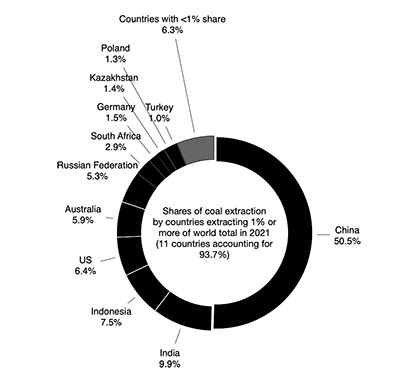
Shane White from www.worldenergydata.org has put together three very useful charts breaking down coal, oil and gas extraction by nation. 

COAL

And the bottom line? The charts show that in 2021, just over half of all fossil fuels was extracted by just seven countries:

  • China
  • USA
  • Saudi Arabia
  • Russia
  • Canada
  • Iraq, and  
  • Iran.

At a glance:

  • Coal: China alone accounted for just over half of total world coal production in 2021, and 11 countries produced 1% or more accounting for 93.7%.
  • Oil: Five countries accounted for just over half (US, Saudi Arabia, Russia, Canada and Iraq). 19 countries produced 1% or more accounting for 87.8% of 2021 world total oil production.
  • Gas: Four countries produced just over half (US, Russia, Iran and China). 18 countries produced 1% or more accounting for 84.4% of 2021 world total gas production.

20 November 2022

Brace for impact. International aviation Net Zero 2050 flightpath crashes in Melbourne.

by Mark Carter, Flight Free Australia

This week Flight Free Australia and Extinction Rebellion picketed the International Air Transport Association (IATA) Slot Conference in Melbourne to protest the airport and airline fossil fuel industry’s emissions expansion plans.

[A landing slot is permission for an airline to take off and land a particular regular flight at an airport.]

Right now we’re the middle of the climate emergency.  

Right now, Melbourne Airport wants to increase its flight emissions by around 60%, creating an extra 160 million tonnes — 50 times more than they admit — by 2046 from flights enabled by its proposed third runway.

28 September 2022

Not on the same page: When science and politics collide in climate communication

by David Spratt 

Not on the same page?
Click image to enlarge.


Updated 29 September 2022

A significant paper on climate tipping points was published on 9 September, Exceeding 1.5°C global warming could trigger multiple climate tipping points. Having co-written a non-specialist’s overview on tipping points earlier this year, entitled Climate Dominoes, I looked forward to the new paper’s conclusions. 

But on the very first page, there was a sense of science and politics on a collision course: the conclusions about appropriate climate goals did not seem to match the evidence, as I will explain below.

Now this is not a new story, but it points to the need to disentangle political conclusions from physical evidence. Often scientific reports and papers pull their punches, especially when it comes to IPCC, as we documented in our Breakthrough report, What Lies Beneath: The understatement of existential climate risks.   But such reticence is not restricted to the IPCC.

The reasons for scientific reticence in the climate field are many, and may include:

02 September 2022

Pakistan is a hotspot for climate-driven human security crises

by David Spratt

A nation’s capacity to respond to climate risks by adaptation  is significantly dependent on its capacity, reflected in the nation’s economic capacity, and poor countries are more vulnerable.

In Pakistan’s case, that vulnerability is magnified by the extent of climate-driven change in the Himalayas and to the south Asian monsoons, as well as ever-more-extreme events: heat waves beyond human tolerance and flooding that has just submerged one-third of the country, killed up to 80% of livestock according to some reports, destroyed a million homes and 2200 miles of roads, and displaced more than 33 million people. “We are witnessing the worst flooding in the history of the country,” said Dr Fahad Saeed, a climate scientist with the Climate Analytics group, who is based in Islamabad.

10 August 2022

High-profile paper on “catastrophic” climate impacts echoes our "What Lies Beneath" analysis on fat-tail, existential risks and IPCC reticence, published four years ago

By David Spratt


Last week, just as a new paper on catastrophic climate risks was hitting the media, I received an email:

“It would appear some scientists are now, finally, openly speaking about what you yourself have long been describing as the 'high end' or 'fat tail' risks associated with climate change and want UN scientists to look into the risks of catastrophic climate change. Here's the link to the article on the BBC website…  On two occasions when reading this article I did punch the air on your behalf; when it mentions the need for more emphasis on tipping points and for the IPCC to produce a special report on catastrophic climate failure..”

It wasn’t the only one.