
by David Spratt
A super El Niño could intensify heat, drought, fire and crop losses across Australia and Asia, while fertiliser shortages raise the risk of a wider food crisis.
The world is heading into a burst of global heating with a developing El Niño that is unprecedented in the observational record. Scientists were shocked when global average warming exceeded 1.5°C in 2024, but now they are estimating 2027 could be around 1.7°C, and a single month in the next year may reach 2°C.
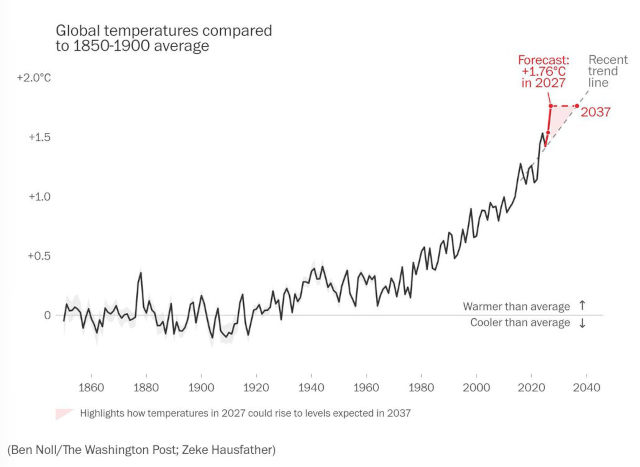
Figure 1: Global average warming is projected to be 1.76°C in 2027 as the full impact
of the El Niño is experienced -The Climate Brink
This is extraordinary, with profound impacts for Australia and the region. An El Niño shifts jet streams, alters rainfall and raises global temperatures, and a ‘super’ event would sharply disrupt global weather, increasing the risk of extreme heat, droughts and flooding, and reducing crop yields. And all this is exacerbated by the ongoing war on Iran, which has cut fertiliser use and production, driving down crop yields.
Even before the full El Niño effect takes hold, food production in Europe has been battered by drought and a series of record-breaking extreme heatwaves. In the USA, the wheat acreage harvested will be the lowest in 149 years. In Korea, potatoes ‘boil’ in the ground as record heatwaves sweep across swathes of Asia. Coffee and cocoa futures have increased by up to 40 per cent as investors anticipate crop damage from Brazil to West Africa and South-East Asia.
Economists say the El Niño could cause a global food price shock lasting into 2028, and push 50 million people into acute hunger before the end of 2027. Máximo Torero, the chief economist at the UN Food and Agriculture Organization, says his big concerns are durum wheat and rice, due to the combination of El Niño and lower fertiliser usage; in Australia, a major wheat grower, and India, the world’s biggest rice producer, yields are threatened.
As well, there is a severe water crisis in Puerto Rico, the Rhine and Po rivers in Europe are at record low levels, the Colorado River is in crisis and reservoirs have shrunk to their lowest levels since they were constructed.
So what exactly is a ‘super’ El Niño? An El Niño was formally declared by US climate agencies on 11 June 2026.
The El Niño-Southern Oscillation (ENSO) is an irregular pattern of change in sea-surface temperatures (SSTs) and winds over the tropical Pacific Ocean. In its warm, El Niño phase, increased westerly winds (weaker easterly trade winds) drive warmer tropical water east towards the Americas and reduce ocean upwelling of cooler deep water, and a positive feedback reinforces this weakening of the trade winds and surface warming. The central and eastern tropical Pacific experiences a marine heatwave.
An indicator of the state of the ENSO is the variation in short-term SSTs along the central-eastern Pacific equator in a zone known as Niño3.4. Negative (cooler) SST readings indicate a La Niña; positive (warmer) readings indicate a developing El Niño. The strongest recent El Niños were in 1997-8 and 2015-6, when SST Niño3.4 warming did not exceed 2.8°C.
Currently, projections based on all models show 4°C warming in Niño3.4 sea-surface temperatures between October and December 2026. It is an understatement to say this is a scientific shock, and constitutes a coming ‘super’ El Niño, far above recent events. This would be more intense than an epochal El Niño in 1877, whose devastating consequences were called a ‘Late Victorian Holocaust’ by the historian Mike Davis.
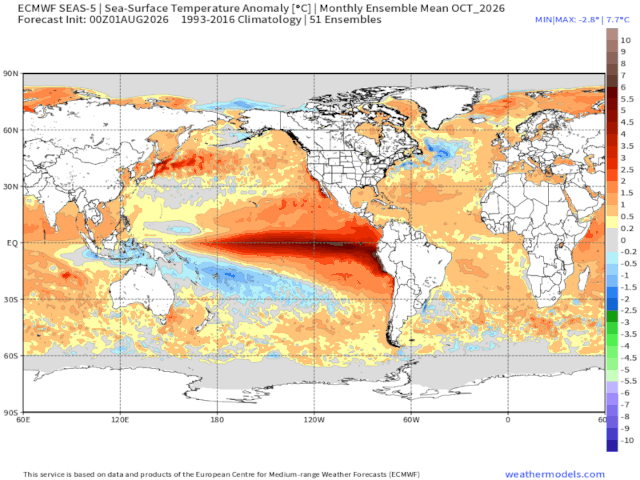
Figure 2: The red streak across the eastern Pacific shows the current hot sea-surface temperatures
in the Niño3.4 band (ECMWF)
Climate change has already made extreme heatwaves more intense and persistent, as Europe, North Africa and the Middle East are experiencing right now, and they are likely to worsen during an El Niño, which adds a layer of heat on top of the trend global warming of 1.5°C. An El Niño brings persistent high-pressure weather systems and hotter and drier conditions to eastern Australia and South-East Asia, particularly Indonesia, and southern Africa. But it also increases rain and flooding in East Africa, parts of South America, and east China. El Niños generally peak between November and February.
A recent study concluded that ‘super’ El Niños are not just passing weather events, but drive ‘climate regime shifts’ that can push parts of the Earth system into new, hotter states, and could shift some regional patterns for decades, including unprecedented marine heatwaves.
El Niño impacts on most of Australia generally include these marine heatwaves, less rainfall and less cooling cloud cover, higher temperatures over land, and more extreme heatwaves, and all leading to higher evaporation rates and more intense bushfires. This super El Niño will likely destroy swathes of the Great Barrier Reef and produce record-breaking heatwaves and severe fire risk, drought and lower crop yields, heat stress for people, domestic livestock and nature, and damage to infrastructure.
In Southeast and South Asia, the El Niño will intensify heat conditions and may weaken or delay the monsoon, affecting staples such as rice and palm oil, pushing up food prices and threatening food security for lower-income households. In Indonesia, a tough dry season is forecast, with a high risk of drought and wildfires.
Crop yields decrease with global warming. For staple crops such as maize and wheat, yields have declined by 7.5 per cent and 6.0 per cent per 1°C of warming and are projected to decline by up to an additional 10 per cent for every 1°C of warming in the future.
An upper optimum during reproduction and crop yield formation of around 30°C is common for many important agricultural crops (e.g. maize, soy, cotton). Other major crops show damaging sensitivities at lower temperatures during their reproductive period (e.g. barley, beans, wheat and potatoes). As well, higher concentrations of carbon dioxide in the atmosphere are already having a serious effect on the nutritional quality of most of the world’s major crops – grains, soya, corn and rice.
Rice is the main source of calories for half the global population and supplies 20 per cent of the global dietary energy. In India, for example, 70 per cent of the caloric intake comes from rice. Summer monsoon rainfall provides up to 80 per cent of the annual precipitation in India.
And even without accounting for all the simultaneous hazards including the fertiliser crisis, scientists say that global average 2°C of warming around 2040 will reduce per capita crop production by one-third in Southeast Asia.
In a recent report, the Australian Security Leaders Climate Group offered this plausible scenario for the next year:
The confluence of the super El Niño and the fertiliser crisis [may] trigger a food crisis in Asia in particular, but also around the world. The energy crisis has increased fuel costs for farmers. Reduced yields lead to higher prices. There will be food shortages, panic buying, price shocks. Many vulnerable countries are poorly prepared for disruptions to food supplies, which can hit hardest in regional and remote areas.
The combined effect of many months of unaffordably high fuel prices and a food crisis across Asia, together with almost unliveable heatwaves, leads to social unrest and conflict in vulnerable countries, much as the global wheat crisis became a trigger of the Arab Spring. Rationing of food essentials is introduced in some countries, but poor administration and corruption lead to riots. Insurgency movements and malicious non-state actors including criminal syndicates utilise the opportunity.
Are we prepared as a nation for this hotter world with a peak El Niño?

