30 September 2012

Climate News

Week ending 30 September 2012
Images: NASA
FEATURED ARTICLE

Arctic Sea Ice: What, Why and What Next
http://blogs.scientificamerican.com/guest-blog/2012/09/21/arctic-sea-ice-what-why-and-what-next/
Ramez Naam, SA blog, September 21, 2012
On September 19th, NSIDC, the National Snow and Ice Data Center, announced that Arctic sea ice has shrunk as far as it will shrink this summer, and that the ice is beginning to reform, expanding the floating ice cap that covers the North Pole and the seas around it.

Interactive map: Arctic sea ice concentration, 1984 and 2012
http://www.abc.net.au/news/2012-09-27/arctic-sea-ice-maps-before-after-1984-2012/4283418

23 September 2012

Climate News

Week end 23 September 2012

PICKS OF THE WEEK

ACT government seeks 90% renewables by 2020
http://reneweconomy.com.au/2012/act-government-seeks-90-renewables-by-2020-2020
Giles Parkinson, Renew Economy, 19 September 2012
The ACT government has outlined an ambitious plan to source 90 per cent of its energy requirements from renewable energy by 2020, with solar, wind and energy efficiency at the centrepiece of its strategy.

Four-degree rise demands 90-degree rethink
http://www.smh.com.au/environment/climate-change/fourdegree-rise-demands-90degree-rethink-20120921-26byz.html
Ian Dunlop, SMH, September 22, 2012
Climate change has moved into a new and dangerous phase. The Arctic has been warming two to three times faster than the rest of the world. In the past few weeks, melting of the Arctic sea ice has accelerated dramatically, reducing the area and volume to levels never previously experienced.

20 September 2012

Arctic warning: As the system changes, we must adjust our science

Update 20 September:
EXTENT: Satellite data shows Arctic melt sea-ice extent probably reached the minimum for the year at around 3.4 million square kilometres on Monday 17 September, 18 per cent less than the previous record in 2007 of 4.2 m.sq.kms. The JAXA daily raw data is here and the NSIDC date is here. This extent is now well less than half of the average extent of the 1980s.

VOLUME: The sea-ice volume is now down to just one-fifth of what it was in 1979. Latest PIOMAS volume from September 3, 2012 is 3407 cubic kilometers of ice remaining in the Arctic. Contrasted with the 16,855 of 1979, that is just about 20 per cent. Extent has dropped further since 3 September, so minimum volume this melt season will be about 5–10 per cent less than the early-September figure.

ICE-FREE ARCTIC: Debate rages within the scientific community. Previously we covered Big call: Cambridge prof. predicts Arctic summer sea ice “all gone by 2015”. On Monday the Guardian reported "Arctic expert predicts final collapse of sea ice within four years", in which Prof. Peter Wadhams of Cambridge said:  "I have been predicting [the collapse of sea ice in summer months] for many years. The main cause is simply global warming: as the climate has warmed there has been less ice growth during the winter and more ice melt during the summer… in the end the summer melt overtook the winter growth such that the entire ice sheet melts or breaks up during the summer months. This collapse, I predicted would occur in 2015-16 at which time the summer Arctic (August to September) would become ice-free. The final collapse towards that state is now happening and will probably be complete by those dates. As the sea ice retreats in summer the ocean warms up (to 7C in 2011) and this warms the seabed too. The continental shelves of the Arctic are composed of offshore permafrost, frozen sediment left over from the last ice age. As the water warms the permafrost melts and releases huge quantities of trapped methane, a very powerful greenhouse gas so this will give a big boost to global warming." Unforntunately, the eviednce is on his side.


Northern Polar Institute Research Director Kim Holmen, left,
with UN Foundation Board Chairman Ted Turner and
President Timothy Wirth in the Arctic
Post of 13 September:
By David Spratt,
published in ReNewEconomy on 12 September 2012
and in Climate Progress on 13 September 2012

The Arctic sea-ice big melt of 2012 “has taken us by surprise and we must adjust our understanding of the system and we must adjust our science and we must adjust our feelings for the nature around us”, according to Kim Holmen, Norwegian Polar Institute (NPI) international director.
     From Svalbard (halfway between mainland Norway and Greenland), the BBC’s David Shukman reported on 7 September that Holmen had described the current melt rate “a greater change than we could even imagine 20 years ago, even 10 years ago”.
     As detailed last week, the thin crust of sea-ice which floats on the north polar sea is now only half of the average minimum summer extent of the 1980, and just one-quarter of the volume twenty years ago.

How British government's climate forecasting MET Office gets the Arctic wrong

Introductory note: It is now very likely that the Arctic will be sea-ice-free within a decade, with enormous consequences. Not only has the 2007 record minimum low been smashed, but the new record low 2012 sea-ice extent (3.4 million square kilometres) is less than half the figure three decades ago. And the volume of ice is now down to just one-fifth of the figure three decades ago. In 1979 the summer volume was 16,855 cubic kilometres, on 3 September this year it was just 3,407 cubic kilometres. 80 per cent of the ice has already been lost.
     The IPCC 2007 got the Arctic sea-ice wrong in projecting an Arctic still containing summer sea-ice by 2100. Now, Arctic specialists relying on new, regional climate models such as Prof. Peter Wadhams of Cambridge are making the big call of a summer ice-free Arctic as early as 2015.  By contrast, those relying for Arctic forecasts on global general circulation models (GCMs) used for the 2007 IPCC report are sticking to a 2030-2040 projection, but lament that “We just don’t know exactly why this (sea-ice loss) is moving so fast”. The predictions of those who rely too much on the GCM models seem strangely removed from the reality on the ground and even a common sense view of the evidence, as this analysis from Arctic News shows. Underestimating the speed and likely future rate of change in the climate system has deadly consequences. – David

UK MET Office keeps downplaying significance of events in the Arctic

by Sam Carana, Arctic News

One of the most respected datasets on Arctic sea-ice volume is  PIOMAS, the  Pan-Arctic Ice Ocean Modeling and Assimilation System developed at the Polar Science Center, Applied Physics Laboratory, University of Washington. The graph below shows PIOMAS data for annual minimum Arctic sea ice volume (black dots) with an exponential trend added (in red).

16 September 2012

Climate News

Week ending 16 September 2012

PICKS OF THE WEEK

Coal company shareholders dudded, says Garnaut
http://afr.com/p/national/coal_company_shareholders_dudded_JZtQMNBDihfjcEAliiYWNN
Ross Garnaut, AFR, 12 September 2012
Labor’s former climate change adviser, Ross Garnaut, has accused coal companies of “dudding” their shareholders by overinvesting in mining projects

Decades Of Deception: The Coal Industry Has Advertised ‘Clean Coal’ Since At Least 1921
http://thinkprogress.org/climate/2012/09/13/845311/decades-of-deception-the-coal-industry-has-advertised-clean-coal-since-at-least-1921/
Stephen Lacey, Climate Progress, 13 September 2012
The coal industry has spent tens of millions of dollars trying to convince people that it can create an environmentally friendly product. However, whether it be the technological and cost barriers associated with capturing and storing carbon dioxide or the devastating impact of mountaintop mining on groundwater, ecosystems and human health, the concept of “clean” coal is a proven myth.

10 September 2012

On thin ice: Time-frame to save the Arctic is melting away

By David Spratt, first published by ReNew Economy on 5 September 2012

 Something extraordinary is happening when graphs of melting Arctic sea-ice have their vertical axis redrawn because the data are falling off the chart.
     But that’s what has occurred in the last 10 days, since the extent of floating Arctic sea-ice broke the satellite-era minimum record on 24 August. On that date it was 4.2 million square kilometres, according to data from the Japan Aerospace Exploration Agency.
     Since then, an additional half a million square kilometres of sea-ice has melted. The extent on 4 September was just half of the average minimum extent of the 1980s. At the current rate of loss, with one to three weeks left in the northern melt season, the minimum may well shrink below 3.5 million square kilometres. This is an astounding story.

09 September 2012

Climate News

Week ending 9 September 2012

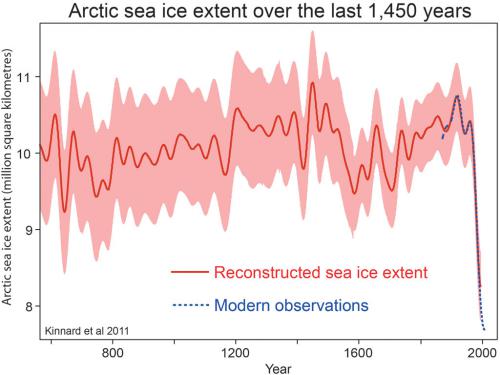
Arctic sea ice extent over the past 1,450 years reconstructed from proxy data by Kinnard et al., with a 40-year low pass filter applied.  Note that the modern observational data in this figure extend through 2008, and thus it is a close approximation of current conditions, even though the extent is not as low as current annual data due to the 40-year smoothing. Courtesy Skeptical Science
PICKS OF THE WEEK

Life Is Sacred
http://www.truthdig.com/report/item/life_is_sacred_20120903/
Chris Hedges, TruthDig, 3 September 2012
Corporations care nothing for democracy, the rule of law, human rights or the sanctity of life. They are determined to be the last predator standing. And then they too will be snuffed out. Unrestrained hubris always leads to self-immolation.

02 September 2012

Climate News

Week ending 2 September 2012
Arctic sea-ice volume 1979 to 25 Aigust 2012
It may seem impossible to imagine that a technologically advanced society could choose, in essence, to destroy itself, but that is what we are now in the process of doing.”
– Elizabeth Kolbert, Field Notes from a Catastrophe: Man, Nature, and Climate Change (2006)
PICKS OF THE WEEK

Grassroots Movements Driving Back Coal Worldwide
http://thinkprogress.org/climate/2012/08/27/746681/grassroots-movements-driving-back-coal-worldwide/
Gordon Scott, Sierra Club, August 27, 2012
The global grassroots movement against dirty, polluting coal-fired power has added another continent to the ranks of those finally moving away from the carbon-intensive fuel source: Australia.

30 August 2012

Big call: Cambridge prof. predicts Arctic summer sea ice “all gone by 2015”

By David Spratt  Published in ReNewEconomy on 30 August 2012

Cambridge Professor and Arctic expert Peter Wadhams

This is one of those moments when the pace of climate change and its consequences become simply extraordinary.
      In the last two weeks, I’ve spent some time trying to unravel the Arctic’s big melt of 2012 and what is means for future global warming and the world we will live in.
      It’s not territory for the faint-heartened, and one of the world’s foremost Arctic experts has stepped up to make a big call, a really big call.

29 August 2012

Arctic melt demands another look at Australia's climate policy

First published in New Matilda, 28 August 2012

There's half as much sea-ice as there was 30 years ago and the annual summer melt keeps smashing records. David Spratt on why Australian policy-makers should be paying attention.

In the last few days something so dramatic has happened in the Arctic that it demands another look at Australia's climate policies.
     On Friday 24 August, annual summer melting of the floating sea-ice in the Arctic Ocean smashed the previous record, with another three weeks of the melt season still to to go. Scientists are calling it "stunning" and "astounding". This breaks the record set in 2007. Back then there were scientific gasps that the sea ice was melting “100 years ahead of schedule”.
     Thirty years ago, the summer sea-ice extent was around 7.5 million square kilometres (similar to area of Australia), but this year it will end up at half that figure.  And the ice is becoming thinner, due to melting from below by warmer seas, and the relentless loss of thicker, multi-year ice. So the volume of the summer ice will in 2012 be only around one quarter of what it was three decades ago.  Now it looks like the sea-ice  will be gone in summer within a decade or so, maybe sooner.  That's what many of the cryopshere scientists and models are saying.

27 August 2012

Arctic sea-ice melt record more than broken, it’s being smashed

by David Spratt, first posted 25 August 2012
UPDATE 27 AUGUST: Sunday's data confirms that the previous sea-ice extent minimum of 24 September 2007 was broken last Friday, 24 August 2012. What is also stunning are sea-ice daily extent figures averaging ice loss of more than 100,000 square kilometres per day for the last four days. This suggest melt is accelerating very late in the melt season in a pattern that has never before been observed. The Arctic this year is heading into new territory and it looks like 2012 may in retrospect be seen as the year when a new melt regime took hold.
      The ice extent is about to drop below 4 million square kilometres for the first time in the satellite record, and the Arctic has shed almost half a million square kilometres of sea-ice in last five days! With three weeks of the melt season still to go, it's not hard to see extent dropping another half a million square kilometres (or more!) to 3.5 million square kilometres. (In previous big melt years of 2007 and 2011, around half a million square kilometres was lost after 26 August.)
    This is starting to make the second graph (below) looking reasonable, and those scientists and models which have been suggesting an sea-ice-free summer Arctic within a decade to be on the money.
     The commentary by Climate Commissioner Prof. Will Steffen in today's newspapers that ''We can expect to see an ice-free Arctic at about the middle of this century'' looks out of touch with the most recent data, and exhibits IMHO a scientific reticence which does a disservice to the urgent public debate we need on implications of the Arctic melt for Australian climate policy (and sea-level rises from Greenland!). Positive feedbacks now have a grip on Arctic sea-ice and the descent appears to be exponential, not linear. Looking at the PIOMASS date on sae ice volume (fifth chart here), its hard to know what Prof. Steffen  has based his assertion upon.
      Perhaps the enormity of the present situation is best summed up by sea-ice blogger Neven: "Basically, I'm at a loss for words, and not just because my jaw has dropped and won't go back up as long as I'm looking at the graphs. I'm also at a loss - and I have already said it a couple of times this year - because I just don't know what to expect any longer. I had a very steep learning curve in the past two years. We all did. But it feels as if everything I've learned has become obsolete. "
Climate change impacts are frequently happening more quickly and at lower levels of global warming than scientists expected, even a decade or two ago. And this week the Arctic has provided a dramatic and deeply disturbing example.
     According to IARC/JAXA satellite data at Arctic Sea-ice Monitor from the Japan Aerospace Exploration Agency, the sea-ice extent of 24 August 2012 of 4,209,219 square kilometres broke the previous record in the satellite era of 4,254,531 square kilometres set on 24 August 2007. Back then the were scientific gasps that the sea ice was melting “100 years ahead of schedule”.
JAXA Arctic sea ice extent to 24 August 2012. Updates: http://www.ijis.iarc.uaf.edu/en/home/seaice_extent.htm

26 August 2012

Climate News

Week ending 26 August 2012
Projected sea-level rise to 2100 (inches). Source City of Boston
PICKS OF THE WEEK

Arctic sea-ice melt record more than broken, it’s being smashed
http://www.climatecodered.org/2012/08/arctic-sea-ice-melt-record-more-than.html
David Spratt, ClimateCodeRed, 25 August 2012
Climate change impacts are frequently happening more quickly and at lower levels of global warming than scientists expected, even a decade or two ago. And this week the Arctic has provided a dramatic and deeply disturbing example.

20 August 2012

Arctic heads for record melt, but do we want to know?

Update to: Dramatic lessons from the Arctic big melt of 2012: It's already too hot, as Greenland melt record is smashed
Related post: US Media Turn A Blind Eye To Record Greenland Ice Melt
by David Spratt, first published at RenewEconomy, 21 August 2012

Two extraordinary events at the end of last week say a lot about the state of the climate change conversation in Australia.
     The first was data from US Arctic researcher Prof. Marco Tedesco showing that melting over the Greenland ice sheet had shattered the seasonal record on 8 August, a full four weeks before the close of the melting season (following image). The melting season lasts until the second week of September each northern summer, so this result is stunning: "With more yet to come in August, this year's overall melting will fall way above the old records. That's a goliath year -- the greatest melt since satellite recording began in 1979," said Tedesco.

Dramatic lessons from the Arctic big melt of 2012: It's already too hot, as Greenland melt record is smashed

Related post: Arctic heads for record melt, but do we want to know?

UPDATE 21 August: RECORD SEA-ICE MELT: The Arctic big melt is charging along and a number of data sets today show that 2012 has broken the 2007/2011 record for minimum sea-ice extent / area. These include data sets from Arctic ROOS and Cryosphere Today. This closeup from Neven of the Cryosphere Today data is very clear:

Cryosphere Today sea ice area August 2005-2012

Cryosphere Today data set shows:
  • 2012, day 230, 2.87743 million square kilometers
  • 2011, day 253, 2.90474 million square kilometers (previous record low)
So it looks like the record has been smashed with another 3 weeks to go in the melt season.  This is almost as extraordinary as the Greenland record melt story below. 

19 August 2012

Climate News

Week ending 19 August 2012
Arctic sea-ice extent decade by decade: the rate of loss is increasing. Source: http://www.ijis.iarc.uaf.edu/seaice/extent/Sea_Ice_Extent.png
PICKS OF THE WEEK

Australians lead in fitting solar panels on homes
www.smh.com.au/environment/australians-lead-in-fitting-solar-panels-on-homes-20120817-24dxd.html
Ben Cubby, SMH, 18 August 2012
Australians put more household solar panel systems on their roofs than anyone else in the world last year, new data from the Clean Energy Regulator and the International Energy Agency show.

12 August 2012

Climate News

 Week ending 12 August 2012

Extensive melt over the Greenland Ice Sheet. This figure shows the daily, cumulative area of the Greenland ice sheet showing surface melt for 2012, 2011, 2010 and for the 1980 to 1999 mean. While melt was unusually extensive through May and June of 2012, the melt area increased rapidly in early July in response to an unusually warm weather event. Source: http://nsidc.org/arcticseaicenews/2010/08/a-most-interesting-arctic-summer/figure6-2/
PICKS OF THE WEEK

Rate of Arctic summer sea ice loss is 50% higher than predicted
http://www.guardian.co.uk/environment/2012/aug/11/arctic-sea-ice-vanishing
Robin McKie, Guardian, 11 August 2012
New satellite images show polar ice coverage dwindling in extent and thickness
AND
Sea Ice Decimated, Huge Storm May Have Broken Arctic Ocean Stratification
http://www.dailykos.com/story/2012/08/10/1118634/-Sea-Ice-Decimated-Huge-Storm-May-Have-Broken-Arctic-Ocean-Stratification

06 August 2012

Beyond Coal and Gas Forum

by Ellie Smith, Mackay Conservation Group

Over the weekend of 28-29 July, over 80 people from all over Queensland, along with some visitors from NSW and Victoria, gathered just south of Mackay to learn about and discuss the impacts of the Central Queensland coal and CSG boom on our environment, communities and economy at the Beyond Coal and Gas Forum.


     The weekend was an extremely energising event. Participants went home feeling more powerful and optimistic about their chances of protecting their communities and their livelihoods from the impacts of the massive boom in coal and CSG that is planned for Central and North Queensland.

05 August 2012

Climate News

Week ending 5 August 2012
Arctic sea-ice volume (red line is 2012) from
https://sites.google.com/site/arctischepinguin/home/piomas
Arctic Death Spiral Continues: Record Low Sea Ice Volume Appears Likely
http://thinkprogress.org/climate/2012/08/04/634901/arctic-death-spiral-continues-new-record-low-sea-ice-volume-appears-likely
Neven, Climate Progress, 4 August 2012
I think it’s pretty safe to say that we’re going to have a new record volume low, although the difference with 2010 and 2011 has become smaller. Right now it’s 1249 and 730 km3 respectively. 

More Arctic charts
https://sites.google.com/site/arctischepinguin/home/piomas

04 August 2012

Are we experiencing more extreme hot weather due to climate change? The evidence is in.

By James Hansen, Makiko Sato and Reto Ruedy (available at PDF here)

The greatest barrier to public recognition of human-made climate change is probably the natural variability of local climate. How can a person discern long-term climate change, given the notorious variability of local weather and climate from day to day and year to year?

Figure 1: Fire fighters battle the Taylor Creek blaze, one of several fires which have burned over 75,000 acres in southeastern Montana in summer 2012. Image credit: USFWS/Gerald Vickers via InciWeb.org.

30 July 2012

Climate News

Week ending 29 July 2012
Global Drought Monitor July 2012   Source: http://drought.mssl.ucl.ac.uk/drought.html
Erratic Weather Across Globe Fueling Impending Food Crisis
http://www.commondreams.org/headline/2012/07/23-0
Common Dreams, July 23, 2012
In addition to the ongoing drought in the United States, experts warn that the potential for a worldwide food crisis is heightened by extreme and erratic weather across the globe.

Extreme Drought Areas in US Nearly Triple in One Week
http://www.treehugger.com/climate-change/extreme-drought-areas-u-s-triple.html
Mat McDermott, Treehugger, 27 July 2012
The drought gets worse: The US Drought Monitor reports that areas on the nation under extreme drought conditions in key agricultural states has tripled in the past week. Furthermore, the amount of land experiencing drought conditions more broadly has increased to nearly two-thirds of the nation, up from 56% just a week ago.

When National Climate Disasters Go Global: On Drought, Food, And Global Insecurity
http://thinkprogress.org/climate/2012/07/18/535661/when-national-climate-disasters-go-global-on-drought-food-and-global-insecurity