21 August 2026

The coming Super El Niño could push a hotter world towards food crisis

by David Spratt

A super El Niño could intensify heat, drought, fire and crop losses across Australia and Asia, while fertiliser shortages raise the risk of a wider food crisis.

The world is heading into a burst of global heating with a developing El Niño that is unprecedented in the observational record. Scientists were shocked when global average warming exceeded 1.5°C in 2024, but now they are estimating 2027 could be around 1.7°C, and a single month in the next year may reach 2°C.
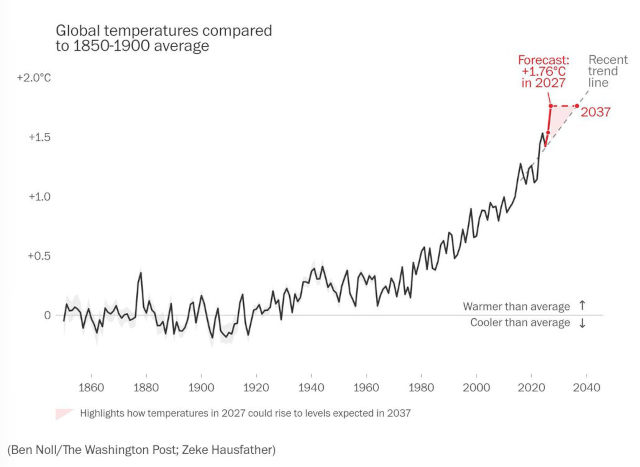
 Figure 1: Global average warming is projected to be 1.76°C in 2027 as the full impact 
of the El Niño is experienced -The Climate Brink

This is extraordinary, with profound impacts for Australia and the region. An El Niño shifts jet streams, alters rainfall and raises global temperatures, and a ‘super’ event would sharply disrupt global weather, increasing the risk of extreme heat, droughts and flooding, and reducing crop yields. And all this is exacerbated by the ongoing war on Iran, which has cut fertiliser use and production, driving down crop yields.

13 August 2026

Australia must rethink leadership in the Trump era – Starting with climate

 by Adm. Chris Barrie (Rtd), first published at The Diplomat 


We live in a rapidly evolving risk landscape. The conflict in the Middle East has not resolved and its effects will last for months, if not years. The Iran-U.S. clashes have transformed into something that strains supply chains, reduces crop yields, rewrites regional politics, and concentrates attention on near-term stability at the expense of the big global challenges.

The decisions by the Trump administration to retreat from the commitments and frameworks of global climate action have created a leadership void that is felt most acutely not in Washington or Brussels, but in the low-lying islands of the Pacific, in the Australian communities already contending with extreme fire seasons and more intense floods and cyclones, and in every boardroom and cabinet room where 30-year infrastructure decisions are being made in the face of deepening uncertainty.

10 August 2026

Could Four Billion People Die at 3°C?

by David Spratt, first published at Safe Climate Australia


The claim that four billion people could die in a 3°C warmer world has become a powerful climate narrative. But what does the science actually support, and where does evidence end and speculation begin?

The proposition that four billion people or more would be dead if — and more likely, when — global warming reaches 3 degrees Celsius (°C) has gained some currency, mainly due to the 4DB (four billion dead) website and associated activities.

Now, that is half the current global population, and on current warming trends of 0.3-0.35°C/decade, the world will hit 3°C around 50 years from now, perhaps earlier, in part because there is little prospect of a rapid decline in fossil fuel emissions.  So that’s a mind-blowing average of 80 million people a year dying due to climate impacts every year from now to 2075? Is that realistic?

The number of greater than four billion dead at 3°C first appeared in a 2025 report on Planetary Insolvency: Finding our balance with nature, published by the UK Institute and Faculty of Actuaries (IFoA) and the University of Exeter.ing our balance with nature, published by the UK Institute and Faculty of Actuaries and the University of Exeter.