22 April 2022

“Climate greatest threat to Australia’s security,” ex-defence chief says

Former Chief of Australian Defence Force, Admiral Chris Barrie during a press conference at the Fuel Security Summit in Sydney. (AAP Image/Bianca De Marchi).

by Michael Mazengarb, first published at RenewEconomy

National security experts have called on Australian voters to use the federal election to support candidates that back strong action on climate change, saying Australia has “squandered” the last two decades.

Speaking at the Smart Energy Council’s Emergency Fuel Summit in Sydney, retired admiral Chris Barrie described climate change as the single biggest threat to Australia’s national security. Barrie currently serves on the Australian Security Leaders Climate Group and said the group saw national climate policy failures as putting Australia at risk.

“We consider that climate change now represents the greatest threat to the future and security of Australia,” Barrie said.

24 March 2022

Retired senior defence leaders name climate disruption as "clear and present danger", call for 2030 decarbonisation goal

by David Spratt

Seventeen senior retired Australian defence leaders have described climate disruption as an "existential threat" and a "clear and present danger", calling for accelerating action with a 2030 decarbonisation goal.

The call came in an open letter to Australia's political leaders, which was also published as a full-page statement in the national The Australian newspaper on 23 March.  Amongst the signatories are Admiral Chris Barrie, the former chief  of the Australian Defence Force, and Air Vice-Marshal John Blackburn AO, the former deputy chief of the Royal Australian Air Force.   The letter is available here.

22 March 2022

Existential climate risk management on ClimateGenn

by David Spratt

Recently I had the opportunity to speak with journalist Nick Breeze, who writes for The Ecologist as well as running his excellent ClimateGenn site (genn.cc). 

The podcast /video are now available. Nick describes our conversation as:

"In this ClimateGenn episode I am speaking with Research Director of the Breakthrough National Centre for Climate Restoration in Melbourne, David Spratt, about assessing climate risk and why incremental tweaks to reduce emissions are failing us.

"We also discuss IPCC forecasts, political failure, and how change is possible but it requires a huge mobilisation of resources, coupled with public and political participation and leadership of the Zelensky variety.

11 February 2022

Don't miss Saul Griffith in Melbourne 20 February


For our Melbourne and Victoria readers...

Saul Griffith's new book ‘The Big Switch’ lays out a detailed blueprint – optimistic but feasible – for decarbonising our economy while creating millions of new jobs and a healthier environment. 

Join Saul for this special Sustainable Living Festival Forum as he reveals exactly what it will take to rapidly transform our infrastructure to zero emissions. 

 Hosted by Walkley Award-winning journalist and broadcaster, Paul Barclay, the event will be recorded and broadcast on ABC Radio National's 'Big Ideas' program.

1pm Sunday 20 February @ The Capitol

Book at https://events.humanitix.com/the-big-switch-australia-s-electric-future

 More information: http://www.slf.org.au/event/big-switch-australias-electric-future/ 

"I’m a scientist, engineer, inventor, and father who wants to leave my kids a better world. The data convinces me that it is still rational to have hope." — Saul Griffith 

02 February 2022

Have tipping points already been passed for critical climate systems? (7) Summing up: Faster than forecast, cascades loom

by David Spratt

Seventh in a series.    Read 1  |  2  |  3  |  4  |  5  |  6  |  7

Image: MaxPixel

Reflecting on the evidence presented in this tipping point series, a number of conclusions may be drawn:

  1. At just 1.2°C of warming, tipping points have been passed for several large Earth systems.  At just 1.2°C of global average warming, tipping points have been passed for several large Earth systems.  These include Arctic sea ice, the Greenland Ice Sheet, The Amundsen Sea glaciers in West Antarctica, the eastern Amazonian rainforest, and the world’s coral systems. The world will warm to 1.5°C by around 2030, with additional warming well beyond 1.5°C in the system after that. Yet even at the current level of warming, these systems will continue to move to qualitatively different states. In most cases, strong positive feedbacks are driving abrupt change. At higher levels of warming, the rate of change will quicken. The meme that “we have eight years to avoid 1.5°C and tipping points” should be deleted from the climate advocacy vocabulary. It is simply wrong.

31 January 2022

Have tipping points already been passed for critical climate systems? (6) Permafrost: Beyond the models

by David Spratt 

Sixth in a series.    Read 1  |  2  |  3  |  4  |  5  |  6  |  7

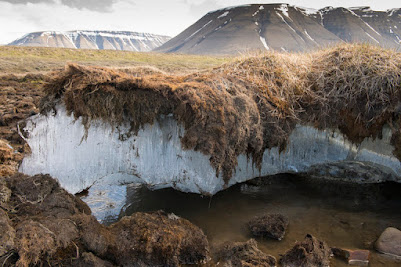
Permafrost is permanently frozen ground. It covers one-quarter of the land mass of the northern hemisphere, and contains 1.5 trillion tonnes of carbon, twice the amount currently in the atmosphere and triple the amount emitted by human activity since 1850.  Permafrost buried beneath the Arctic Ocean holds 60 billion tons of methane (in structures known as methane clathrates) and 560 billion tons of organic carbon.

Permafrost is releasing significant amounts of greenhouse gases, and feedbacks are under way, but the dynamics are not yet well enough understood to be able to judge whether tipping points have been reached or not.  As previously noted (in part 1 of this series), University of NSW researchers point out that: “We do not know exactly how close we are to a tipping point, or even whether we have already passed it… There are tipping points that while not yet triggered may already be fully committed to.” 

28 January 2022

Have tipping points already been passed for critical climate systems? (5) Coral Reefs: A death spiral

by David Spratt 

Fifth in a series.    Read 1  |  2  |  3  |  4  |  5  |  6  |  7

Updated 2 February 2022.

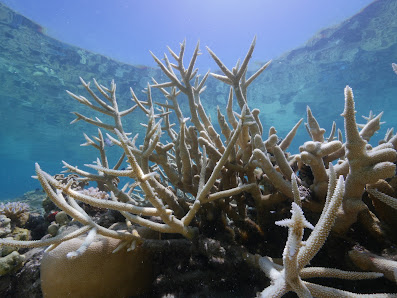
Great Barrier Reef bleaching 2016

Ecosystems, including coral reefs, mangroves and kelp forests in Australia, are degrading fast as the world's sixth mass extinction gathers pace. 

Coral polyps are invertebrates similar to minute jellyfish, which build limestone structures, and live in a symbiotic relationship with algae-like unicellular zooxanthellae that reside within the coral structure, and give it colour. The coral provides the algae with a protected environment and compounds they need for photosynthesis. In return, zooxanthellae supply the coral with oxygen, glucose, glycerol, and amino acids, which are the products of photosynthesis. 

26 January 2022

Have tipping points already been passed for critical climate systems? (4) Forests and the Amazon: A faltering carbon sink

by David Spratt

Fourth in a series.    Read 1  |  2  |  3  |  4  |  5  |  6  |  7

Deforestation in the Brazilian Amazon.
Image: Chatham House


The plant-based terrestrial biosphere may be understood as including the world’s land-based plants, soils, derived dead organic matter, such as litter, and soil organic matter. 

Plants photosynthesis uses carbon dioxide and water to produce sugar (glucose) and oxygen. Around 30% of the additional carbon dioxide (CO₂) produced by human actions has been drawn down from the atmosphere (mitigated) by increased plant photosynthesis. This adds to the land-based sink of stored carbon. But plants also respire, for example at night and in winter, by converting oxygen and stored glucose back into water and carbon dioxide. 

As the planet continues to warm, a point of warming is reached — the “thermal maximum for photosynthesis” — after which combination of the rate of photosynthesis decreasing and the rate of respiration increasing results in the net flux of CO₂ from the atmosphere decreasing.

24 January 2022

Have tipping points already been passed for critical climate systems? (3) Greenland and the Arctic: Abrupt change

by David Spratt

Third in a series.    Read 1  |  2  |  3  |  4  |  5  |  6  |  7

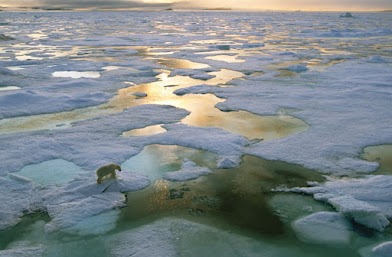
Broken-up Arctic sea-ice
“The Arctic is screaming”, says Mark Serreze, Arctic climate expert at the US National Snow and Ice Data Center.

Arctic warming is racing ahead of the worst-case estimates, now heating four times faster than the global average, and the region is undergoing abrupt climate change, understood as a transition of the climate system into a different mode on a time scale that is faster than the responsible forcing. In other words, it has passed a tipping point for rapid, system-level change. 

Researchers say that the Arctic “is currently experiencing an abrupt climate change event …  climate models underestimate the abruptness of the recent changes observed in the Arctic (and) climate models underestimate this ongoing warming”. [Models do not account well for warming due to sea-ice loss, but losing the reflective power of Arctic sea ice in the summer months would advance the 2ºC threshold by 25 years”.]

20 January 2022

Have tipping points already been passed for critical climate systems? (2) West Antarctica and the "doomsday" glacier

 by David Spratt

Second in a series.    Read 1  |  2  |  3  |  4  |  5  |  6  |  7

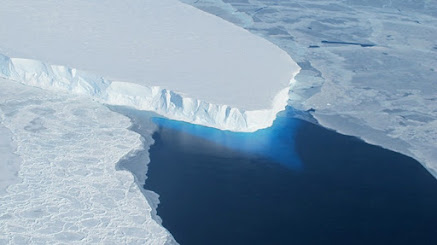
Thwaites Glacier fractures. Image: NASA
The Thwaites Glacier in West Antarctica has an eastern ice shelf 45 kilometres wide as it flows into the Amundsen Sea. On 13 December 2021, scientists announced that the ice shelf is likely to break apart in the next five years or so, resulting in a speeding up of the glacier’s flow and ice discharge, possibly heralding the collapse of the glacier itself, and triggering similar increases across the Amundsen Sea glaciers.

The researchers explain: “Over the last several years, satellite radar imagery shows many new fractures opening up… which like a growing crack in the windshield of a car [can] suddenly break apart into hundreds of panes of glass. We have mapped [the] pathway the fractures might take through the ice [and conclude] the final collapse of Thwaites Glacier’s last remaining ice shelf may be initiated … within as little as five years” (emphasis added).

18 January 2022

Have tipping points already been passed for critical climate systems? (1) The basics

by David Spratt

First in a series.   Read 1  |  2  |  3  |  4  |  5  |  6  |  7

Tipping points and potential cascade effects
As global heating reduces the extent of floating Arctic sea-ice each summer, the heat-reflecting ice is replaced by heat-absorbing dark ocean water, adding energy to the Arctic system, driving more melting. This is a “positive feedback”, a self-reinforcing change. Examples abound in the climate system. On Greenland, for example, warming is reducing the height of the ice, and this lower elevation means it will melt more, because the temperature is higher at lower altitudes. 

Sixteen years ago, James Hansen warned that “We live on a planet whose climate is dominated by positive feedbacks, which are capable of taking us to dramatically different conditions. The problem that we face now is that many feedbacks that came into play slowly in the past, driven by slowly changing forcings, will come into play rapidly now, at the pace of our human-made forcings, tempered a few decades by the oceans thermal response time."   

31 December 2021

Climate stories and insights in 2021

 by David Spratt

So here is an idiosyncratic look at some of the big climate stories and insights from 2021, drawn from my Twitter feed.

Note: If this does not display properly in the email alert, go to Climate stories in 2021

08 December 2021

Morrison’s lack of climate action puts national security at risk, former defence chief says

by Michael Mazengarb, first published at RenewEconomy,

A former Australian defence force chief has warned that a lack of strong climate policies and the Morrison government’s failure to properly assess the implications of a warming planet is putting the country’s national security at risk.

“Climate change remains the most significant threat to our security, and we must now act accordingly with the necessary scale and speed of action,” former Australian Defence Force chief Admiral Chris Barrie said, speaking on behalf of the Australian Security Leaders Climate Group (ASLCG).

“It is perplexing that a government that claims to be strong on security issues is weak, and even silent, on the greatest threat to the future security, safety and well-being of all Australians.


04 December 2021

After Glasgow, a climate reality check

The pledges made at COP26 global policy-making conference in November will not prevent 1.5℃ or even 2℃ of global warming. The outcome from Glasgow leaves a role for fossil fuels for many decades to come.

As a climate advocate, you know the underestimation of the climate reality poses grave consequences for global safety, health and well-being.

Get the 2021 Climate Reality Check, presenting an update of 20 critical observations and insights to help advocates address the climate emergency and support actions for a safe climate.

  • Stop increasing additional warming: Advocate for zero emissions by 2030 
  • Prevent imminent damage: Support safe near-term cooling research; innovation 
  • Restore safe climate conditions: Encourage large scale drawdown of pre-existing emissions

View the short explainer video and download the full Climate Reality Check 2021 for the latest analysis.

2021 Climate Reality Check:

  • Presents a sound scientific foundation to increase vital awareness and help frame effective strategy.
  • Highlights major trends and impacts to emphasise urgent and severe vulnerabilities.
  • Confronts risks and threats with rigour and unrestrained honesty.
  • Identifies critical actions essential for safe climate global protection.


02 November 2021

With "net zero 2050" and the 1.5°C in the same breath, Glasgow reeks of cognitive dissonance

by David Spratt

So far most of the media coverage and advocacy at COP26 has been poor and severely misinformed. One after another  politicians, business leaders, journalists and NGO advocates talk about "net zero 2050" and the 1.5°C Paris goal in the same breath, and get away with it.  This gross underestimation of the climate condition is utterly delusional, and very few seem to be calling it out.

"Net zero 2050" (NZ2050) is a con, as this blog has reported over and over again, as did this Breakthrough report.  Central bankers have NZ2050 scenarios in which fossil fuels constitute 50% of primary energy use in 2050.  When the Murdoch media endorses the NZ2050 climate goal, you know it is the problem and not the answer. 2050 is so far away it's a reason for procrastination.  Judging by the G20 outcome, even NZ2050 and a coal phase-out may not pass muster in Glasgow.  China is on net zero by 2060 and India on net zero by 2070.

26 October 2021

"Net zero 2050" is a deadly scam justifying fossil fuel use way past 2050. It is not to be celebrated.

by David Spratt

DOWNLOAD Briefing Paper: Net zero 2050 is a dangerous illusion

Should the Australia Government be congratulated for finally, and in a completely empty manner, saying it supports a "Net zero 2050" climate target?

The answer is no, because as RenewEconomy put it today, the government's announcement is “A joke" Morrison’s net zero plan has net zero detail, and no change to policies."

Writing for RenewEconomy some weeks ago, Ketan Joshi declared that the Murdoch media empire "hasn’t seen the light on climate – they’re just updating their tactics". And the tactic of doing a 180-degree climate back-flip and with a straight face supporting "Net zero 2050" (NZ2050) is two-fold: to smooth the climate path for Prime Minister Morrison as an aid to his reelection chances; and to be on the winner's side when the architects of climate procrastination have their way in Glasgow in November.

21 October 2021

Security leaders on Glasgow COP26: Water shortfalls mean we can’t wait for 2050

 by Chris Barrie and Ian Dunlop, first published at The Australian

[Reproduced with permission of the authors]

Net-zero emissions by 2050 will be sold as the success story of the Glasgow climate conference next month, but this may be at the expense of commitments for deep emissions cuts this decade that are of primary importance in preserving human and global security.

The problem is that 2050 is too far away and an excuse for procrastination. The chief executive of a large financial institution recently was reported as saying it was “easy for bosses to commit their companies to net-zero carbon emissions because it was ‘next, next, next, next management’s problem’”. Ditto politicians.In reality, what the world does in the short term matters most, especially when it comes to maintaining human and global security, based on water and food security, in a climate-disrupted world. 

12 October 2021

From dust to dust

 Today's blog is  a guest post from filmmaker James Bartlett, who is looking for support for a short climate film, From dust to dust. 

Australia has long been dragging its feet on the global stage in our obligation to dramatically reduce our carbon footprint to zero. As the efforts of other nations begin to dwarf our own, it has become painfully clear that our elected government cares little about the impacts of climate change. What are the implications of this ambivalence and where are we heading?

From Dust to Dust is a third-year-graduation project by students at the Australian Film, Television and Radio School (AFTRS) that explores these issues. This 12-minute drama, with elements of absurdity and black comedy, takes place in a near future; an environment that is barely habitable after decades of abuse and ignorance. Small towns are suffering the effects of the climate crisis, where fresh water has become increasingly difficult to attain. For some rural areas of Australia, this is already a reality.

20 September 2021

Renowned climate scientist warns rate of global warming during next 25 years could be double what it was in the previous 50

A Nov. 30, 2019 view of the Jaenschwalde Power
Station near Peitz, eastern Germany.
Credit: John MacDougall/AFP via Getty Images
This blog over the years has given a lot of space to the incredible work of the "godfather" of modern climate research, James Hansen. He has consistently pointed to the "Faustian bargain" of high levels of sulfate aerosol emissions, largely a product of burning fossils fuels, which are masking much of the current warming. Our posts have included  Faustian bargain revisited: study finds zeroed emissions will add 0.25-0.5C of warming as aerosol cooling is lost, Quantifying our Faustian bargain with fossil fuels, The astounding global warming impact on our oceans that will reduce cloud cover and bring tears to your eyes,  What must climate and energy policy really achieve? It's time for a... and 1.5°C of warming is closer than we imagine, just a decade away which was written in 2018 and turned out to be closer to the mark than most in the climate action movement were prepared to admit at the time. In this article, Bob Berwyn talks about Hansen's recent temperature projections and the role of aerosols.

by Bob Berwyn, Inside Climate News

James Hansen, a climate scientist who shook Washington when he told Congress 33 years ago that human emissions of greenhouse gases were cooking the planet, is now warning that he expects the rate of global warming to double in the next 20 years.

While still warning that it is carbon dioxide and methane that are driving global warming, Hansen said that, in this case, warming is being accelerated by the decline of other industrial pollutants that they’ve cleaned from it.

06 September 2021

When Murdoch endorses the "Net zero 2050" climate goal, you know it is the problem and not the answer

 by David Spratt

DOWNLOAD Briefing Paper: Net zero 2050 is a dangerous illusion

The Murdoch/News Ltd global media empire, which makes a living out of post-science politics, promoting Covid vaccine denialism and providing a platform for climate skepticism, has decided to swing its weight behind the "net zero 2050" (NZ2050) climate goal, according to media reports.

The decision is being coordinated across Murdoch mastheads, a clear sign that the newspapers owners, not individual editors, call the tune and that editorial independence is a myth. 

Writing for RenewEconomy, Ketan Joshi declared that "News Corp hasn’t seen the light on climate – they’re just updating their tactics". And the tactic is two-fold: to smooth the climate path for Prime Minister Morrison as an aid to his reelection chances; and to be on the winner's side when the architects of climate procrastination have their way in Glasgow in November.